Showing posts with label St Peter's Church. Show all posts

Tuesday, 25 August 2015

Flawborough

Street View

You need a car if you live in Flawborough .... or a horse.  There are no shops, no schools ... in fact there are no amenities at all ...and the bus service is dreadful: it goes to Newark once on Wednesdays and Fridays.  I don't imagine many people here use it anyway.  This is a small but affluent place tucked away in the middle of nowhere. 


 It is rather popular with cyclists, precisely because it has the feeling of a traffic-free area.  In fact a friendly resident told us the cyclists were becoming a bit of a problem. The Flawborough residents have had to make a stand because nearly every summer weekend a cycle race was being planned through their village. Great for the cyclists but rather inconvenient when you were trying to drive home.  You can't hear them coming: her dog was ran over by a bike a few weeks ago so she is not a great fan.


The day we visited the road was far from traffic-free. A surprising number of lorries kept trundling through the narrow lanes.  It is a farming community and this time of year there's lots of produce to move about. They use trucks instead of tractors to cut the number of journeys.


St Peter's Church
 Our visit began at St Peter's Church, the only building in the village that isn't a house.  A notice on the gate told us it is up for sale. I hadn't even walked through the gate before my mind was converting it into a house.

It has stood empty since 2009 so it needs some work.  A couple of glass panes need replacing but the front door is amazing ...


  I was just beginning to wonder about a garden full of graves when the gravestones took my attention.  They are old and fabulous:

Slate Gravestone

                                                 Slate Gravestone

 Lots of Swithland slate dating back to the early 1700s but the inscriptions have hardly weathered. The backs of the slabs are not smooth so you can see how much work had to go into producing these headstones: with no help from machinery they had to cut the stone to size, polish the front then carve the inscription.  On some of them the stonemason hadn't quite got the spacing right or he made the odd spelling mistake so words or letters were added above the line!  There is an example in the penultimate line on the one below.


                                                                        Slate Gravestone

 These stones all have a motif called the Belvoir Angel - a round angel face with wings at the side. The Belvoir Angel is only found in this area of the country.  You can see how it developed from the naive design above to a more rounded figure in later years.


 The terrible infant mortality rate is also shown in the very sad inscription above.


  This one is particulary special - the stonemason didn't carve it - the letters are all raised!  How long would that have taken him with just a hammer and chisel!! Amazing work.


 While we were in the church yard a village resident came to chat.  Apparently the church, when sold, can't be converted into anything ... a business could move in but the graveyard will continue to be used so my dream house will never be. This friendly resident was baptised in the church and plans to be buried there. Her family, the Hawthornes, have lived here for years.

Flawborough Equine is a World Class Equine Rehabilitation Centre based in Flawborough and  Flawborough Farms cultivates the land around the village and nearby Alverton. Both are owned by members of the Hawthorne family.  Prior to 1955 Flawborough Hall and the estate belonged to Major Edward Harold Spalding but he never had children of his own so on his death he left the property to his farm manager ... Mr Hawthorne. Obviously this was big news at the time.  It was equivalent to a huge Lottery win today.  The Hawthornes were the Golden Couple of Flawborough for a time!  It is his son and grandson who run the farm business today.

Flawborough Hall

Major Spalding had been in the retail trade during his lifetime.  Back in1878 his father was part of a partnership .... Griffin & Spalding ... who purchased a small corner shop across the road from Old Market Square in Nottingham.  Ten years later they bought the shops on either side. Their sons ... our Major Spalding ... took over during the 1920s when a remodelling of the building underlined its importance as a retail centre for the city. (That must have taken some thought as the amalgamation of different shops meant there were 37 different floor levels in the building! No wonder I always get lost when I go in there!) The Mikado Cafe, on the ground floor, was described in a magazine of the time as being part of  “a fashionable store in town noted for high fashion and furs and has something of a reputation of the seafront at Brighton as a place where people liked to be seen in the latest fashions.”  The store sold those fashions and furs, furniture and household goods all at competitive prices; they had a 'never knowingly undersold' scheme and the customer was always right.  Sounds like my kind of shop! As a side line they also provided upholstered seats and carpeting for cinema (a growth market in the 1930s).  In 1944 they accepted an offer for the business and Debenhams took over. 


There is a monument to the Spalding family in St Peter's Church, Nottingham:


"A dark grey marble oval with gold lettering commemorating John Tricks Spalding (1844-1924) and his sons William Arthur (1872-1963) and Edward Harold (1873-1955). John Tricks Spalding was Mayor of Nottingham and churchwarden of St Thomas’ Church. Edward Harold Spalding served as High Sherriff of Nottinghamshire in 1951."


Street view

One of the lost villages of Nottinghamshire was sited very close to here.  Dallington was just down the lane but there's no sign of it now. Apparently the Plague reduced the population and land enclosure finished it off.


Sunday, 9 August 2015

Sibthorpe


Wolsey car
Sibthorpe has the feeling of being a place people drive through to get to somewhere else ... but it was an important community in the past.  It was the home of a wonderfully charitable clergyman who was brutally murdered for his trouble.  It was home to a boy who would grow up to crown a King of England and a man who would snub another King's Chancellor.   Its old buildings included a "very large mansion" and a college chantry ...but in their place today there is a dovecote and a horse.

There are traces of old buildings and the fish ponds in these fields.
Sibthorpe village with a church are mentioned in the Domesday Book.  Around 1185 Robert de Sibthorpe gave the church to the Knights Templar.  It passed to the Knights Hospitallers after 1312 when the Templars were disbanded.  A few years later Thomas de Sibthorpe acquired it.

Street view: Sibthorpe

Thomas de Sibthorpe,  Parson of Beckingham, was an important man; he was a Parliamentary Clerk. a Justice of Assize as well as a Justice of the Peace and during the course of his early life he inherited, or acquired, portions of lands in Sibthorpe. In 1326 he established a chantry there and expanded this into a college chantry over the years.  A warden was appointed as a secular priest who conducted services every day in the newly built church of St Peter and prayed for the souls of Thomas de Sibthorpe's family (and other important people) in a special Mass once a year.  There were eight or nine chaplains to help him, as well as at least three clerks and a few choir boys.  One poor, or weak, man from the village was employed as gate-keeper and one poor woman helped to clean.  These were fed every day with the others and provided with a new garment of clothing every year.  The warden was responsible for distributing money to the poor of the village once a year and sharing out seven loaves of bread every Monday, Wednesday and Friday. They had land and fish ponds to provide food.  The chaplains were expected to be sober, chaste men of learning (one was appointed to be a school teacher paid by his pupils) all in Holy Orders but not bound by rules like in a monastery.   It sounds like a wonderful set up (ignoring the threat of the Black Death .... the second Warden probably died of the plague .... and the possibility of leprosy .... once appointed chaplains kept their position for life unless they misbehaved or contracted leprosy).  The system seemed to ensure no-one starved and everyone lived in peace and harmony with Thomas de Sibthorpe picking up the bills!  What a great guy!

Church stone work


King Edward III visited Nottinghamshire in 1345 and was so impressed with the college he told "the sheriffs, bailiffs, ministers and all purveyors and takers of victuals and other things for the King’s household that the King had taken under his special protection the chapel of St Mary, Sibthorpe, with the warden and chaplains thereof and their lands and possessions, and nothing was to be taken of their crops, hay, horses, carts, carriages, victuals and other goods against their will."


 To ensure his money was spent wisely Thomas routinely checked the accounts.  In 1351 the third warden must have had something to hide.  This was Robert of Kneeton who, along with a group of accomplices, murdered Thomas in order to avoid the audit. They were tried and convicted of  seditious killing.  Their victim being a Royal Clerk and JP their actions were deemed to be treasonous so the punishment was to be drawn and hanged as traitors.  The first Great Statute of Treasons, which is still part of present day law, was drawn up a few months after this event and it is thought the Sibthorpe murder had an impact on the content of the Act.

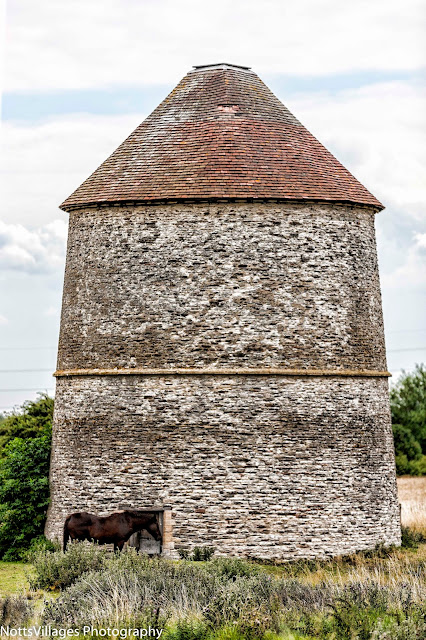
Sibthorpe Dovecote


The college chantry continued after Thomas de Sibthorpe's death but a famine hit the county and this is thought to have led the monks to build the impressively large Sibthorpe Dovecote in 1370.  There are 1334 nest holes inside .... plenty of tasty pigeon pies! There is an interesting metal gate next to the church, it leads to the path to the dovecote.  We expected it to be locked and bolted but we were wrong.  The inside is dark but it is easy to see the nest holes and the size of the structure.  The door is tiny .... we didn't want to climb inside.  Hard to imagine having to go in there with 2,000 pigeons flapping about!

The college didn't survive Henry VIII's reforms.  It passed into the hands of Thomas Magnus, the very wealthy Warden of Sibthorpe, in 1545 and Richard Whalley of Screveton.


In 1530 Cardinal Wolsey came to Southwell to escape the stress of Henry VIII's court.  He had
displeased the king by failing to persuade the Pope to
annul Henry's marriage to Catherine of Aragon.  Wolsey was a man used to a life of luxury in Hampton Court Palace: the Southwell residence did not meet with his approval.  He wrote to Thomas Magnus asking to stay with him at the Hall in Sibthorpe.  Magnus didn't exactly say no but his reply was enough to put Wolsey off by describing his "poor house [having] not above three chambers to be occupied for lodgings, the residue are applied for corn and husbandry, which maynteynneth and kepeth my priests and servants there…… Surely my said house is not the thing as it is reported to your Grace. If it shall please your said Grace to repair hither ye shall have the haull, kechynne, buttrye and pantrye, all in one, the seller, a little dyning chamber, two chambers, one withynne another, and a chapel; and the other ende of the haull to be reserved for myself agenst my coming. There are other things not easfull for your Grace, there is noe lodging to be had in the village, about the house, neither mete nor drinke, the people be soe poor, nor fewell withynne 10 or 12 miles. And for baking and brewing but only straw.’  The poor house described was in fact a "very large mansion" that stood near the church. Magnus was looking out for his own career as he knew Wolsey was out of favour at court. 

Old yew trees in the church yard.

Another influential family with connections to Sibthorpe village were the Burnells. King Henry VIII gave Thomas Burnell the Manor of Winkburn, near Southwell.  Thomas's eldest son, William, was auditor to Henry VIII and  inside the village church is an impressive alabaster monument to Thomas's younger son, Edward.

Tomb of Edward Burnell


It was commissioned by his wife, Barbara.  Sound familiar?  Yes, we have come across her before .... this is Barbara (step-mother to twenty five kids) who married Edward after the death of her first husband ... Richard Whalley, whose impressive alabaster memorial sits in Screveton's church! This one is very ornate but I think she spent more on Whalley's tomb.  This gruesome skull is part of the carving!


St Peter's Church, Sibthorpe

Near the altar inside the church is a beautiful Easter Sepulchre.

Easter Sepulchre Sibthorpe

There are very few of these structures left.  On Good Friday the crucifix, wrapped in linen cloth, would be placed in the sepulchre and candles lit around it.  Parishioners stood guard until Easter morning Mass when the cross was removed.  This represented Christ being placed in the tomb then rising again on Easter morning.  Obviously this ceremony, being closely connected with Catholicism, was frowned upon after the Reformation.  Many of the Easter Sepulchres were destroyed during the 16th and 17th centuries.  It is thought this one survived because it was covered in straw, plastered over and the Burnell tomb placed in front of it.


 There is only one stained glass window ... to the memory of the college founder.


Yew trees and church yard


This is the church Thomas Secker would have attended as a child.  Secker was born in Sibthorpe in 1693.  He took Holy Orders and rose to become Archbishop of Canterbury in 1758. He was a favourite of King George III: Secker had played a major part in some important moments during the King's life .... Secker had baptised, confirmed, crowned and married him!  Strange that Aslockton makes so much of Archbishop Cranmer but there isn't any thing to say Archbishop Secker was connected to this village.


Records show that in 1880s there was a baker, a blacksmith, a shoemaker, shopkeepers, a school mistress, carriers and farmers living here.  Sounds like a prosperous, thriving place.  By 1922 there was an agricultural engineer, a cycle agent, a motor garage and a threshing machine owner.  Today it is a very quite place even on week days.


Well, one old Wolsey may have been put off coming here but along the main road are a few more old Wolseys that appear to have found a good home.


I'm pleased we took the time to stop on the way through here ... we didn't meet any of the residents but we got to know about some interesting people.

Map of Sibthorpe: click here