
The name probably derives from the Old English word hwǣte meaning “wheat”, so this is the 'Wheat Village'.
The Vale referred to is the Vale of Belvoir. The village has a fine view of Belvoir Castle, seat of the Manner family.
 |
| The road to Whatton |
For younger readers who may be asking "Who are the Players?" I will digress for a moment:
 For many
years Player Cigarettes was one of Nottingham's major employers. Around 11,000 people worked for Player in the late 1950s.
For many
years Player Cigarettes was one of Nottingham's major employers. Around 11,000 people worked for Player in the late 1950s.
In 1877 John
Player bought a small but successful tobacco company in West Lothian then set
about moving it to Nottingham. He obviously
had high ambitions from the start as he built three factories but rented out
two of them to lace manufacturers until his business expanded into the space.
The
company introduced pre-rolled cigarettes as well as selling the usual loose-leaf Virginia tobacco and papers. This proved very successful. By the 1930s two-thirds of all
cigarettes bought in Britain came from the Player factories with the run-away
favourite brand being Navy Cut. Walter Raleigh would have been proud!
Production
peaked in the 1950s but health scares, taxes and a ban on advertising began
to affect the industry. Player closed
the doors of their factory for the last time in 2016 and production in
Nottingham ceased after almost 140 years.

In 1066 William the Conqueror granted Whatton Manor to Gilbert de Grand with jurisdiction over the manors of Aslockton and Hawksworth. Today Aslockton is the much larger of the two villages so it seems odd to think of little Whatton as being the more important.
Gilbert installed Robert de Whatton as Lord of the Manor. Robert's son Walter succeeded him then Walter's son Robert took the title ... but in 1189 a woman got a look-in! Adelina, became Dame of the Manor. A year later she granted the church and some land to Welbeck Abbey in memory of her father and her late husband (William, Lord Heriz of Gonalston) and paid the King 100 marks to entitle her to marry someone of her own choosing! When she did marry Adam de Novo Mercato (Newmarch) the Manor passed to the Newmarch family. She gained a husband but lost control of her fortune.
The Newmarch family passed on the Manor through the generations (or through the marriage of daughters) until 1840 when Thomas Hall bought the property for his grandson Thomas Dickinson Hall. By 1841 a large country house had been built:
 |
| Whatton Manor |
Thomas Dickinson Hall was a great philanthropist. Yet another local pointed out to us that a number of the cottages round the village had the letters TDH carved above the door as Thomas made improvements to the living conditions of the residents. The family also spent a lot of money restoring the church. One of their sons, Thomas Kendrick Hall (b 1848) was the vicar at Whatton for a time. In 1890 he visited Australia and was returning home with his two young nieces when the steamship on which they were travelling, the Quetta, hit a rock and sank. Rather like the Titanic it had been built with seven compartments to hold water if the hull was ruptured. Like the Titanic the accident happened at night when most passengers were in bed. The rock left such a large hole along the ship it sank within five minutes. Most of the passengers perished. The crew, who were on deck rather than sleeping, fared rather better. One of Thomas Hall's nieces survived ... she spent 36 hours in the water though before the rescuers found her.
Thomas's mother, Sophia Elizabeth Hall, paid £3,000 for St Thomas's Church, Aslockton. to be built as a memorial for her son. Their eldest son, Cecil, also died early (aged 30 in 1874) in an accident at Whatton but I haven't yet found out what happened.
The Hall family sold the property in 1919 when it was purchased by the Players.
We spoke to another villager who recalled Lady Player opening up the grounds to hold a village fete each year. She remembered eating sandwiches on the lawns as a small child ..... sounds like P G Wodehouse's Blandings. Well, the lovely old house was demolished in the 1964 so we couldn't see much once we had walked through the tree avenue to get there. A 'smaller' house was discernible through the large hedge and the stable block still stands ….
 |
| Whatton Hall Stud Farm |
… today it is a successful stud farm: they have bred quite a few winning race horses and thoroughbreds. Their most famous resident was Overdose, nick-named the Budapest Bullet as he was renowned for his sprint finish. This was a dream horse. As a yearling in 2005 he was purchased for 2000 guineas but he went on to win hundreds of thousands of pounds for his new owners. He died in 2015.

In order to return to the village centre we had to cross the exceedingly busy A52. This has never been an easy task ….
In 1892, Mr W Hardy, coachman, was travelling from Whatton Manor to Aslockton Railway Station when he rounded a corner to find a steam roller in his path. The horse veered and overturned the carriage. Luckily no one was seriously hurt. Unlike an incident a few years later ....
December 1913. Mr George Leverington, a 22 year old chauffer, was found guilty of dangerous driving and causing the death of three people. The Bench at Bingham Court House believed that had Leverington been driving at a more moderate speed the accident would not have happened. Evidence revealed he had been travelling at 15 miles per hour!

.jpg)
Whatton church was built in the late 12th to early 13th centuries but has undergone many restorations since then. One took place in 1807 when the pews were installed: another, in 1870/1871, was overseen by Reverend T. Butler, the vicar of Langar and father of the famous author Samuel Butler.

The church has a large steeple with a peel of eight bells. One of these bells dates back to the early 1400s - pre-Reformation times - meaning Thomas Cranmer of Aslockton heard that same bell as it rang him to church four centuries ago!
Inside the church are even older relics which Cranmer would have seen in slightly better condition … I am referring to the effigies of two members of the de Whatton family.

Whatton and Scarrington churches are only a few miles apart yet both are dedicated to Saint John of Beverley, Archbishop of York.
The most famous cleric associated with this village is Thomas Cranmer (1489 - 1556), Archbishop of Canterbury, during the reign of King Henry VIII, King Edward VI and Queen Mary I (at least for a short while!) who was born in Aslockton but spent his childhood days in and around Whatton.
He was instrumental in setting up the split from Rome and founding the Church of England. In 1547 King Edward VI granted Archbishop Cranmer both the rectory at Whatton and at Aslockton.
When Henry's daughter Mary succeeded to the throne in 1553 she was intent on reintroducing the Catholic faith: during her reign over 280 religious dissenters were burned at the stake .... Thomas Cranmer was one of them.
His family worshipped in Whatton Church and his father was buried there in 1501. On the floor of the Cranmer Chapel is a life sized memorial to Cranmer's father.
.jpg)

The church has a large steeple with a peel of eight bells. One of these bells dates back to the early 1400s - pre-Reformation times - meaning Thomas Cranmer of Aslockton heard that same bell as it rang him to church four centuries ago!
Inside the church are even older relics which Cranmer would have seen in slightly better condition … I am referring to the effigies of two members of the de Whatton family.
 |
| Robert de Whatton |
Robert de Whatton was Cannon of Welbeck and vicar of Whatton from 1304 to 1310.
A brass plaque explains the effigy was restored in 1892 by three of his descendants all apparently still connected with the village: Hugh de Heriz, John Swift and Arundell Blount.
A short verse is attached to the plaque:
Wonder not mortal at they quick decay
See! Men of marble piecemeal melt away
When whose image we no longer read
But monuments themselves memorials need.
Crabbe
At first reading it appears to be the usual verse warning the living that their days are numbered but the middle of the first line seems clumsy. Changing the tone and voice and putting emphasis on Wonder rather than Mortal gives a different meaning. He is suggesting these effigies of men are things of WONDER: they are not mortal. Their flesh has decayed so they have risen in the next world. You can see the men of marble disappear in your imagination: the dead effigies are alive and deserve credit as they are working for our salvation even now.
The poet is George Crabbe (1754 - 1832). the clergyman associated with nearby Muston and Chaplain to the Duke of Rutland. His work was admired by Samuel Johnson and Sir Walter Scott while William Wordsworth was counted among his friends.
 |
Effigy of Richard de Whatton
|
The second effigy is Richard de Whatton (1274 - 1336) who, in 1322, supported King Edward II in his battle against the Barons and was well rewarded with confiscated castles and estates from Thomas Planyagenet, Earl of Lancaster. His crossed legs indicate he 'crossed the seas' to take part in one of The Crusades. The effigy is beautifully carved and makes Richard look very comfortable lying there with his feet up!
Shame the same can't be said for poor old Sir Hugh Newmarch. His effigy lies nearer the front of the church but he is minus one leg! Apparently the church warden in days long ago used to use the effigy to break firewood each week when heating the building before the services. He was obviously too enthusiastic one week as the leg dropped off. This effigy is also well carved but in a surprisingly different way. At one time the church doubled up as a school room ... bored pupils added their own carvings to the figure.
A large number of them appear to have names beginning with W!
 |
| Sir Hugh Newmarch .... plus graffiti. |
There are ten beautiful windows here all glowing like rainbows in the rain: some of these are memorials too. Thomas Dickinson Hall, his wife Sophia and their son Cedric have windows: the one commemorating Sophia is by C E Kempe. He was a life long friend and collaborator of the famous architect, G F Bodley. Kempe's work can be found in York Minster, Chester Cathedral … and the church at Clumber Park ... as well as numerous other places. The window portrays the Annunciation of Christ's Birth. Look closely ... you might find the wheat sheaf (Kempe's trademark).
 |
| C E Kempe window |
In my opinion the most outstanding window in the building is dedicated to William and Elizabeth Harrison and their two sons, William and Edwin. This window was designed by William Morris's company no less, from a design by the Pre-Raphaelite artist Burne Jones.
Bodley worked with Morris & Co for a number of years but began to look around for more traditional artists to complement his own Gothic style. Obviously I can appreciate the beauty of Kempe's work but the Morris window beats it for me. Just look at the oranges, lemons and flowers behind the saints. ... not to mention the Pre Raphaelite faces on the angels .... wonderful!
 |
| William Morris window |
This one was totally special! At the top are the cymbal bashing, trumpet blowing angels ….
 |
| Details of William Morris window |
Christ is depicted in the centre window ...

On his right is Saint Peter, keeper of the heavenly keys and the rock on which the Church was built.

Saint John the Baptist, the messenger who prepared the way for Christ's arrival, stands on Christ's left.

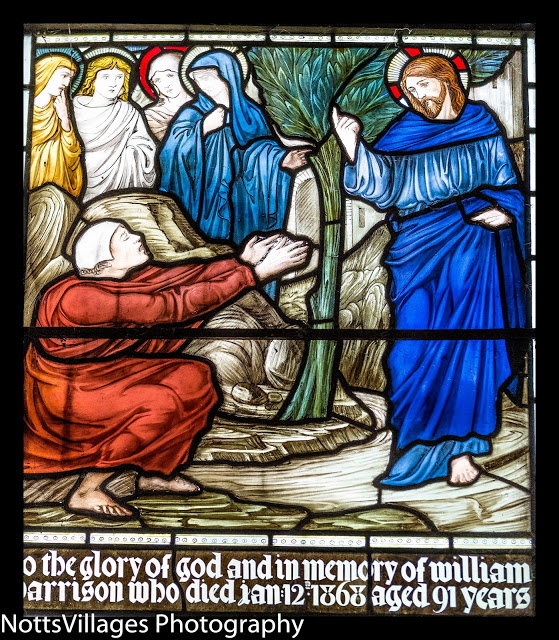
Above Christ is giving sight to a blindman while below he is raising the dead ...

…. lastly he is curing the lame.

These artistic gems may be one of the best kept secrets of Nottinghamshire.
 |
| It is I be not afraid. |


 |
| Christ preaching to labourers with laundry and spades |
 |
Rebecca at the well; St George &
St John of Beverley ordaining Bede
|
 |
Gethsemane; the Crucifixion;
Annunciation & Last Supper
|


Another Pre Raphaelite window is by Heaton Butler and Bayne Their work can be found in Chester Cathedral and Westminster Abbey. The window designer was Robert Turnill Bayne. He sported a wonderful full beard and moustache in real life and tended to include at least one bearded figure in his work where possible. Here is a very dapper Christ.
 |
| Heaton, Butler & Bayne window |
These windows form a superb art exhibition by renowned artists: all for free!
And the art exhibition continues in the grave yard where talented local stone masons were responsible for seven listed head stones.

They all belong to the Carpendale family who were buried here between 1710 and 1748.
Two hundred years later two members of the Houghton family were also laid to rest here. William Houghton, 61, and his youngest son, Jasper, 20, lived at Hill Top Farm. The family also owned the Mill. In early January 1914 two life insurance policies were taken out on Jasper's life to the value of around £15,000.
A few weeks later Jasper and his older brother, John Fredrick, went to the Mill with a Clerk to measure the height of the structure. The Clerk held the measuring tape on the ground while the brothers climbed to the top. According to the Clerk he suddenly heard a cry from above and saw Jasper struggling on the narrow platform. When the brothers returned to the ground Jasper was rather shaken and reported the ladder had slipped and Fred had managed to grab him before he fell. He did not accuse his brother of pushing the ladder but this became a possibility in the Clerk's mind in February when Jasper was killed.
 |
| Whatton Mill |
On that fateful day the family had eaten the evening meal and Fred said, "Good night," and went upstairs to bed. Jasper followed soon after. A moment later the parents heard a gun shot. Jasper had been shot in the face. Mr Houghton ran to the stairs and Mrs Houghton was then horrified to hear a second shot and her husband tumbled back down covered in blood.
At his trial the jury were told that Fred was heavily in debt and had persuaded his brother to take out the insurance policies. As the eldest son he stood to inherit the insurance money, the farm and the Mill once his brother and father died. Mrs Houghton had to give evidence against her son. He suffered 14 epileptic fits while on remand and three doctors testified that he was insane at the time of the crimes so he was sentenced to be detained at his Majesty's pleasure.
Originally the Mill had sails but after the murders it was never worked again and has fallen into disrepair. It is a Grade II listed building.

Whatton residents were incredibly friendly. They stopped to chat and were proud to share their knowledge of their village. It has a lovely rural feel to it helped by the farms that edge the village, so even while you are standing close to houses, there are sheep staring at you from under a tree or cows watching you walk by. A very quiet, tranquil location.

This really is a very picturesque village filled with Olde Worlde charm. On the driveway of a house along the A52 we came across this:
 |
| Steam Engine from Whatton at the Riverside Festival |
As in other villages the older buildings have been converted into houses. Here is the Old Forge:

Beautiful isn't it?!
Unfortunately this is all that is left of the village pub:

The Griffin was a popular establishment in years gone by. During the summer months Whatton used to be a popular 'tourist' spot for Nottingham factory workers. On Bank Holidays and festival days in the late 1800s the pub landlord, Mr. Tomlinson, would organise entertainment and lay on food and ale. The building has now gone and new houses stand in the old car park.
 |
On the other side of the green, behind a large wall, set in beautiful grounds, is Whatton House.

There is a bit of a dark side to this idyllic setting, however, as towards the Bingham side of the village there is a rather large fence surrounding HM Whatton : a secure Category C Prison.
Google map: Whatton


