Tuesday, 1 November 2016

Hickling

The Basin
The Basin sits at the heart of this village right next to the main
 road and the pub.  A couple of swans were sleeping on the bank while mallards and coots fell out with each other in the water.  The benches were filled with people throwing bread to them, encouraging more disputes.  It is a lovely scene but a quick look around and you can imagine what used to happen here.  This was part of the busy Grantham Canal.  Heavy mooring bollards line the banks where large barges docked obviously in quite large numbers.  Nearby is the Canal Warehouse, a Grade II listed building.  This stretch of the canal (from the Trent to the Leicestershire border) was authorised for construction in 1793.  Lord Middleton of Wollaton Hall employed James Green as surveyor of the project ... The Duke of Rutland at Belvoir sponsored the rest.  James Green was not the first choice as surveyor: at the time William Jessop was the Number 1 canal builder and he actually accepted the job but fell ill so took on the role of supervising the whole thing while Green did the work.  Together they created the first English canal entirely dependent on reservoirs for its water supply.  It was obviously a lucrative project for all concerned: although the building costs went well over budget the debts had all been paid off by 1805 and shareholders began to see a return on their investments.  James Green had a beautiful large house built for himself  (Lenton Abbey House)  in the middle of what is now the Nottingham University Park.

Canal Warehouse
 The canal towpath gives walkers, fishermen and cyclists easy access to the counytyside next to the canal and on the day of our visit we could see it was well used.  Our route took us away from there into the village itself.  There are 31 listed structures in this village - 17 houses, headstones in the church and parts of the canal itself.

View of St Lukes
We made for St Lukes Church and phoned the very friendly warden who came and showed us round.

St Lukes
The graveyard is filled with more good examples of the 18th century slate headstones, some with Belvoir Angels, but it was the stone embedded in the church wall that grabbed our interest.

Church wall
As the church warden pointed out it had obviously been cut down to fit but it was still in very good condition to say it is over 600 years old.  Conservationists suggested it should be removed and brought inside to protect it but the idea was not acted upon.

ID  TS   J736


To get inside we had to pass through this wonderful 14th century oak door.  The iron work is just beautiful and the door itself shows damage dating back to the days of the English Civil Wars.

Church door

Inside is an alms box dated 1685: some of the pews obviously belong to the same period as the poppy head carvings are being worn away by generations of use. This old table is supported by bits from an old four poster bed ...

Carved table

 .... but you hardly notice these objects because your attention is immediately drawn to the brightly coloured East window.  It dates back to 1839 but bits of the glass are actually from the original medieval windows   This window was commissioned by William Mandell, B.D., vice-president of Queens' College, Cambridge.  Queen's College hold the advowson for the church (they have the right to nominate a suitable candidate for a vacant church living for this parish)so, as you would expect, a number of incumbants were Cambridge men.

East window
Tucked away in a small dark room at the back we found The Queen's College Coat of Arms next to the Royal Coat of Arms of George II.  These paintings date back to the early 1720s.

Arms of the Queen's College Cambridge

Arms of King George II

 As you walk down the aisle you feel the need to walk round this very imposing brass. but it is rather a tight squeeze.  This is the Babington Brass ... a memorial to Ralph Babington, a rector of the church.  It is the finest example of a brass in the East Midlands and just makes you want to grab a sheet of paper and get rubbing!

Babington Brass
 Ralph Babington died in 1521 before Henry VIII broke with Rome.  Sixty five years later (1586) his great nephew, Anthony Babington, was planning to kill the Protestant Queen Elizabeth I in order to give the throne to a Catholic monarch, Mary Queen of Scots.  Mary had a legitimate claim to the throne (Mary's son James VI of Scotland would become James I of England in 1603 when Elizabeth died) so Elizabeth was keeping a very close eye on her rival.  Letters between Babington and Mary were intercepted, the Babington Plot was revealed and they were both tried and executed for treason.


"HERE LIETh THE BODY OF THE REVEREND M RICH COKE CURATE OF THIS PARISH WHO DEPARTED THIS LIFE THE 9TH DAY OF DECEMBER IN THE YEAR OF OUR LORD 1724 AND IN THE 25TH YEAR OF HIS AGE"


Closer to the altar is the cover of a one-thousand year old Saxon coffin.  It has been described as "one of the finest things of its kind in the land" (Arthur Mee Nottinghamshire).

Saxon coffin cover


The grave cover was so impressive we didn't really notice the stone 'slab' laying nearby ... once I started reading about the church I wish I had taken more notice!  We had ignored the 'Vaux tombstone' (you can see a photo here).  It was found in the graveyard in 1983 and moved into the church to protect it.  You can see where the effigy of  William Vaux, 3rd Baron Vaux of Harrowden, used to lie and round the edge the Latin inscription reads; 'Here lies William Harrowden on whose soul may God have mercy. Amen.'

William Vaux was another renowned Catholic.  His second wife was Mary Tresham whose grandfather Thomas Tresham was a leading figure in Henry VIII's court.  Unfortunately her young nephew Francis Tresham was not so popular with the royals ... he was fined £3,000 (around half a million pounds in today's money) for his involvement in the Essex Plot against Queen Elizabeth I then, even more disasterously, he ganged up with Guy Fawkes! Historians believe it was Francis Tresham who sent the warning letter to his relative that lead to the discovery of the Gunpowder Plot.  Luckily for him Francis died before he could be brought to trial - they chopped his head off his dead body and branded him a traitor anyway.


...... & Albert

Chair carvings .... Queen Victoria

Near the altar are a couple of chairs with a happier connection to our royals.  Instantly recognisable carvings of the young Victoria and Albert in the early days of their marriage (we won't spoil the mood by metioning his untimely death!).

Church interior

Village road sign
Half an hour in this church and you feel like you have wandered into a time machine! (The Southwell Church Project has a detailed description of St Lukes here).

One historical detail I discovered since  our visit concerns a child who was born in Hickling in July 1865.  He was orphaned at just 3 months of age and adopted by an American family then taken to Farmington in Michigan.  His name was Fred M Warner.  He grew up to be an American politician and serve as the 26th Governor of Michigan from 1905 to 1911.


Hickling
We thanked the warden for his time, left the church and continued into the village The old properties are surrounded by new builds but the place has a good community feel.  We saw notices for the village cinema group and the Village Scarecrow Festival; there were lots of people about passing the time of day and even the gardens had a cheerful look to them. 

Hickling

We found the old methodist chapel ... which is now a house ....

Old methodist chapel

... and the old school .... which is now the Village Hall ...

Village hall

Then we decided to wander back towards the pub.  This was not our first visit to The Plough ... a cosy atmosphere, good real ale and they serve local produce on the food menu so what is not to like? Nothing! We will be back .... I fancy a walk along that towpath someday soon.  Who knows we might find hidden treasure.  In 1771 a farmer was ploughing a field near by when he unearthed an urn containing 200 silver coins and medals buried there in Roman times.  Must remember to bring the metal detector next time!

The Plough

 Map of Hickling: click here.

Hickling

Wednesday, 12 October 2016

Kinoulton


Kinoulton village
If the name of Arthur Lowe is mentioned people today probably imagine the officious Dad's Army character ("Don't tell them your name, Pike!"). Well the Arthur Lowe who lived in Kinoulton was not that one ... this Arthur Lowe (1865 - 1940) was a Fellow of the Royal Society of Arts. No, I had never heard of him either but Monet and Turner spring to mind when you look at his paintings - most of which show scenes from around Kinoulton.  This one is in fact entitled Kinoulton Village:


 Here is the Grantham Canal:


During his life time he exhibited at Nottingham Castle and at the Royal Academy amongst other places.  After his death in 1940, at Kinoulton, his widow donated his work to different galleries around the north of England.  I think Nottingham Castle should borrow them all back for an exhibition.

Village Sign

Kinoulton is surprisingly large .... but the present village boundary incorporates the historical sites of more than one village and its centre has moved about over the course of the centuries!

The name indicates the village was originally a tun or farmstead.  It belonged to a wealthy woman named Cynehild.  The Domesday Book records it as Chineltune, no church is recorded and it had very little value (being worth only 2s 8d).  The lost village of Newbold, just next door, was far more significant ...  £10 in the Domesday accounts.  The lord of the manor at the time was Morcar (died 1087), the Earl of Northumbria.  Here was a powerful family.  His grandmother was the wonderful Lady Godiva and his sister, Ealdgyth, was married to King Harold. In 1066 Morcar and his brother were defeated in battle at York when Harold's brother Tostig made a bid for the English crown.  Harold had to quickly march north to save the kingdom at the Battle of Stamford Bridge.  William the Conqueror in the meantime landed at Hastings and had plenty of time to organise his troops before the exhausted English army marched south again to be defeated.  Morcar and his men did not turn up for the Battle of Hastings and later submitted to the newly crowned William so keeping his lands and titles.

Over the next few years Morcar fell in and out of favour with William but by 1071 William decided he was sick of Morcar's insubordination and threw him into a dungeon.  The Newbold manor was given to William Peverel ... one of 164 given to him at the time!  He was obviously a favourite of the king but then rumour had it that Peverel was William the Conqueror's illegitimate son.

Today the foundations of the manor house and the surrounding crofts and tracks are still visible from aerial photographs and Newbold is a listed and protected site under Historic England but for many years the village had faded from memory.  It is not clear why it was deserted but some historians think its close proximity to Colston Bassett probably holds the answer.  In 1604 Colston Bassett suffered a terrible plague: the village was completely closed off for a time and historians think the Newbold villagers took themselves away to safer places.

  A second 'lost village' that made up present day Kinoulton was Warberge.  It lay on the Plumtree side but very little else is known about it.

Mosiac of the church embedded in the church path.


During the 12th century the de Villiers family were lords of Kinoulton (looking after it for the real owners, the Butlers of Warrington).  Now we came across the de Villiers at Tythby (remember poor little Beatrix de Villiers madly in love with King John but he forced her to marry one of his noblemen?)  Well, the family seat here was Kinoulton Castle, a defensive structure.  Yes, a castle! Now don't start imagining large stone turrets and deep moats ... this was not fortified. There was a civil war taking place at the time. The de Villiers together with the Butlers of Warrington fought under Ranulph, Earl of Chester, and supported the future King Henry II.  Just up the road at Gotham the Earl of Leicester also had a castle.  He hated Ranulph and supported King Stephen but the de Villiers and Leicester made a pact as neither wanted the expense or inconvenience of having to defend their lands. After Stephen's death in 1154 Henry II became king and demanded the destruction of all unlicensed castles so Kinoulton Castle disappeared. (The deVilliers family didn't disappear though ... in the 1600s George de Villiers was to be the bedfellow of King James I; close advisor to Charles I and son-in-law to the Earl of Rutland).
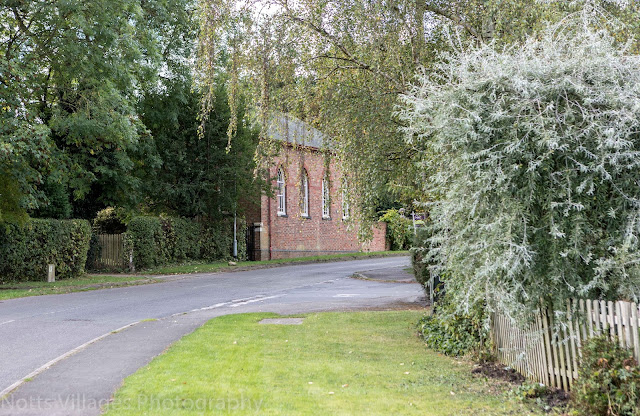

Chapel...now a private residence.

There is a tale that Archbishop Cranmer had a palace in Kinoulton. Apparently it used to stand near the site of the old church on the hill and had been converted into a grange. Briscoe writing Old Nottinghamshire in 1884 agreed that this was possibly the case. He explained that until 1793 the village church was St Wilfrid Church which had been built during the 12th century by Roger Archbishop of York. Cranmer was a prelate for the see of York before being promoted to Archbishop of Canterbury so it is possible he had some connection to this parish as it is so close to his Aslockton birthplace. Kinoulton parish was a 'Peculiar' which meant vicars there had the power to hold civil courts; he could grant marriage licences, hold probate and dish out punishments for misdemeanours.  This status had arisen because the archbishop of York once had a residency in the area. According to one 18th century incumbent, "... four Archbishops of York resided sometimes at their palace here; no trace of which remains except the moat."  so we know there is an archbishop connection but there is no evidence to suggest Cranmer had any official connection with this parish.

The Hall
 They know how to look after the clergy in these parts ... the archbishops had palaces but the vicars didn't do too badly either.  The Old Rectory (not photographed) was designed by the famous Nottinghamshire architect, Thomas Chambers Hine.

The church graveyard.

St Wilfrid church stood on a hill about a mile outside of the present day village. Many years ago a large old granite stone also stood in the middle of the fields near the church.  Today we would have seen it and deduced a glacier had dumped it there.  Very logical ... the residents of Kinoulton were far more imaginative! Apparently when St Wilfrid's was newly built the devil himself was visiting Lincoln and was so furious at the sight of the new structure he threw the rock intending to destroy the little church.  Luckily he missed.  White (History of Nottinghamshire 1832) says the rock was part of a druid temple but it had been broken up and used for building material before his book was published.

St. Luke's

Time did the devil's work ...  the church fell into disrepair and by 1780 the village congregation were using a more conveniently placed chapel (probably an old barn) near the village centre. The Earl of Gainsbourgh stepped in and built St Luke's Church in 1793 using bricks from the local brick yard. Only the foundations of the old church remain ... and few gravestones.  I wonder if it was one of these 'abandoned' headstones that a village baker used to line his oven.  An old local story tells us the baker was discovered when a customer noticed his bread was imprinted with "in loving memory".
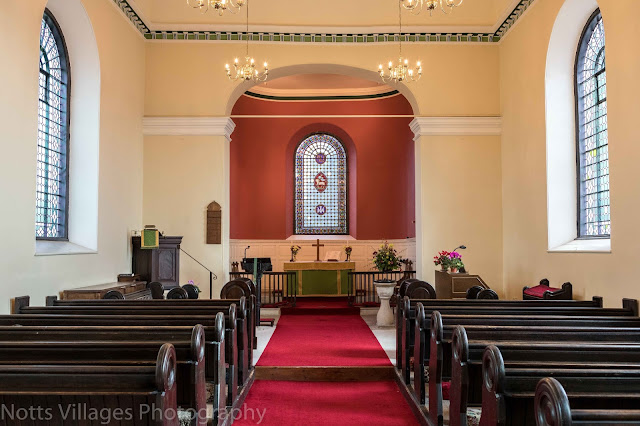
St. Luke's interior


We visited on a Sunday so it is hardly surprising that the church was busy but the service had ended and the people had all stayed to chat and enjoy a coffee.  They were most friendly and welcoming, taking us inside to show off their well kept Georgian church. They have rearranged the pews to make room for a small coffee area and once a week the building turns into a Post Office ... very convenient!


Stained glass window.


The Earl of Gainsborough who built the church was Charles Henry Neville Noel Esq. The very welcoming village pub is called the Nevile Arms (with one L). Part of the famous family from the Tudor court. *

The Nevile Arms and balloon!

In 1928 Sir William Jesse Hind, a wealthy Nottingham solicitor, bought the pub and changed the name to the Hind Arms.  The locals were not impressed and mounted a petition to get it changed back.  Sir Jesse left a different landmark behind but that too has sadly disappeared for the time being.  He planted a row of 184 poplar trees along Vimy Ridge (that runs between Owthorpe Lane and the canal tow path) that until recently could be seen for miles around.  They were planted to commemorate the death of his son, Jesse Francis Montague ( "Monty "), and other fellow officers at the Battle of the Somme during the First World War.  Unfortunately the trees grew to over 90 feet and became quite hazardous so had to be felled in February 1998.  Saplings have been planted in their place so the landmark will return given time.

A tree stump near this sign is all that remains of "the splendid Turkey oak, perhaps commemorating victory in the Crimea" mentioned in The Nottinghamshire Village Book (1989) produced by the WI.

I would liked to have met Sir Jesse Hind.  He sounds like a very social minded person. He is described as the "Friend of Crippled Soldiers". Following his son's death he founded and equipped a pioneering orthopaedic ward to treat injured servicemen.  His farm at Kilnoulton was an agricultural training ground where ex-servicemen and orphans could gain qualifications and work experience all at Jesse Hind's expense. 


The Old Bakehouse.

 In 1769 Kinoulton became quite famous as a spa retreat and dressing rooms were constructed near a local spring after the water was said to have healing properties.   The spa is named on modern maps but the paths to it are overgrown now.

Bailey Row

Village life today is still based around rural activities but a large proportion of the residents now commute elsewhere for work.  The old barns have been converted into comfortable homes for people not animals and the rows of workers' cottages given a facelift.  The Grantham Canal is no longer filled with brick and coal barges and the towpaths are used for country walks.  The village has changed with the times.

The Nevile Arms

Nevile Arms and hot-air balloon

Hot-air balloon over Kinoulton
We finished our walk around Kinoulton with a decent pint of Harvest Pale in the Nevile Arms. We seem to be on a good run with village pubs at the moment. North of the A52 most villages seem to have lost their pubs but south of the A52 and east of the A46 all appears to be well with a tally of nine pubs in nine villages so far.
Map of Kinoulton: click here.

Old safe


References:
History of Nottinghamshire by W White  (1832)
The Nottinghamshire Village Book  By Notts WI  (1989)
Old Nottinghamshire by J P Briscoe  (1884)
Nottinghamshire Guardian by W E Doubleday


* An "aside":  Some modern literary scholars claim that William Shakespeare was not actually the author of the plays: Henry Neville has been put forward as the real genius behind the name.  Another candidate is Roger Manners the 6th Earl of Rutland (more information here).

Saturday, 3 September 2016

Cotgrave


 I could start by telling you that Cotgrave has a very long history: Ice Age flint tools have been found here and a Neolithic monument with eight Bronze Age burials; a 6th century Anglo Saxon burial ground where seventy-four adults and thirteen children had been laid to rest (one of the adults had been buried with a shield and spear) has been excavated at Mill Hill just outside the village and there's also evidence of an Iron Age settlement .... but I won't!  Instead I will tell you that tucked away in the graveyard at Cotgrave are Robert Dalziel Runcie and his wife Ann.  They were the parents of Robert Runcie, Archbishop of Canterbury (1921 - 2000) .... now the great man himself never lived in Cotgrave but it stands to reason that he must have visited the place and his story is worth telling!

At the age of 24 Runcie was awarded the Military Cross for bravery.  His citation reads as follows:

 'One of his three tanks was knocked out by an anti-tank gun and set on fire. Runcie discovered that one of his men was trapped in the tank and went across open ground under enemy fire in order to pull out this remaining man who was unconscious. He succeeded in getting him out.' Citation for Gallantry for the Military Cross: March 1945

The following day he was involved in a battle to destroy three anti-tank guns making him the only modern-day Archbishop who is known to have killed someone.


Runcie's son, James, is a successful writer of novels and television scripts.  Recently he has been working on Grantchester, a popular TV series based on a crime fighting clergyman with a wartime past ... the character is loosely based on Archbishop Runcie.


The Cotgrave Cross (which is a stone column not a cross!) is situated just outside the churchyard on the corner of the very busy main road junction.  It looks like a really old village monument but photographs from the 1920s reveal it was not in situ then so this is a relatively 'new' addition.  The stone pillar itself dates back to the 16th century but, according to a local forum, it was discovered and dug up from the Rectory garden then placed at the crossroads ... hence the name The Cotgrave Cross. 


The large village War Memorial is in the churchyard.  A suggestion to move the Cotgrave Cross to make way for the Memorial was discussed recently but rejected because of the cost.

Cotgrave was the home of a war hero.  Ernest Hayes was awarded the Military Medal three times during the Great War, one of only 180 men to do so.  He survived the war but died in Beeston in 1938 aged only 39 years old. His brother John Hayes died in action and has no grave just a commemoration on the Thiepval Memorial.

The Cotgrave branch of the British Legion are involved in a project to record the personal, family and military histories of the fourteen men who gave their lives in the First World War.  It really brings these young men to life for us: Earl Manver's under-gardener who enlisted at 15, was quickly promoted to lance corporal then died aged 17; the 22 year old who bought an engagement ring but died before popping the question and two young neighbours who enlisted on the same day and were killed within a few weeks of each other ...  one of these lads lived in Vine Cottage whilst (Ernest Reeve) had lived right next door at the Rose and; Crown.  If you follow the link to his name you will see just how much the pub has improved since his day!!


We called in to the pub while we were passing and enjoyed a refreshing half an hour in the sunny garden.  The place has a friendly atmosphere and a good selection of well kept ales .... a place we will definitely be going back to visit.


We tried but failed get into the All Saints' Church because we visited on a weekday (the church is open Saturday mornings and Sundays). Parts of this building date back to the 12th century but the Domesday Book records "half a church" here in the 11th century. During an outbreak of the plague in 1637 the church was used to store food with a hollow stone filled with vinegar being used to disinfect money paid for the goods.  According to Wikipedia that stone is still inside the church. Ninety-three people, including forty-six children, died from the disease.  That was about a fifth of the population.

Apparently the church had to be restored (by John Cunnington, architect) after an arson attack in 1996 and two modern stained glass windows were added: one commemorates the farming traditions of the village and the second one shows the connection to mining.

You can get detailed information and photograph about All Saints' Church from the Southwell & Nottingham Church History Project. 


The population of Cotgrave exploded in the 1960s when Cotgrave pit was opened.  Until then records show a population of 700 to 800 but within a couple of years this figure was 5000 and grew to over 7000.  Large housing developments sprang up round the old village centre.  Experienced miners from other pits were encouraged to move into these new, fully furnished homes.  At first it was people from other Nottinghamshire pits but when miners from Gatehead began to arrive older residents remember special meetings being arranged where local people mixed with the new-comers in order to get used to the different accents and dialects ... a vital health and safety issue in the dangerous mining industry of the time.

Princess Margaret cut the first sod at the inauguration in 1954 and nine years later the mine began to produce coal: the first Notts mine south of the River Trent.  All the coal was destined for the Ratcliffe on Soar Power Station.  The pit hit problems in the late 1980s: it lost over £11m in 1988/9.  Coal production ended in 1992.  There are records of ten fatalities over the 32 years it was in operation.  (Link to a history of the pit).

Today the site has been developed into a country park and more housing is being built there.
This further development will hopefully be good news for the area. The shopping centre could do with a bit of updating but it sits next to a children's park and both are clean, tidy spaces.


 One area the locals can feel very proud of is the excellent primary education offered by the local schools.  Candleby Lane Primary School is a leading light in sharing outstanding practice across Nottinghamshire.  Cotgrave Church of England School is rated Good by Ofsted and pupils with Special Educational needs fro 3 - 19 years of age can attend Ash Lea School.


From a social point of view there are two public houses still in business ... quite an achievement these days! A third pub was built in the 1960s but closed in 2004 and was replaced by new houses. The old Miners' Welfare, now the Social Club, boasts a main hall capable of seating several hundred people, one of the largest fully equipped stages in the East Midlands, several bars and entertain suites, snooker rooms and a large garden ... showing what a thriving community this was when the pit was open. Obviously the pit closure caused a few economic issues but the village has weathered that storm and continues to grow.


Map of Cotgrave: click here.